Short answer
No, not in the way most people mean it. You can’t wire the speaker outputs of two amplifiers into the same subwoofer voice coil. Doing that will, in the best case, trip both amps into protect; in the worst case, it will let the two amps fight each other and destroy one or both.
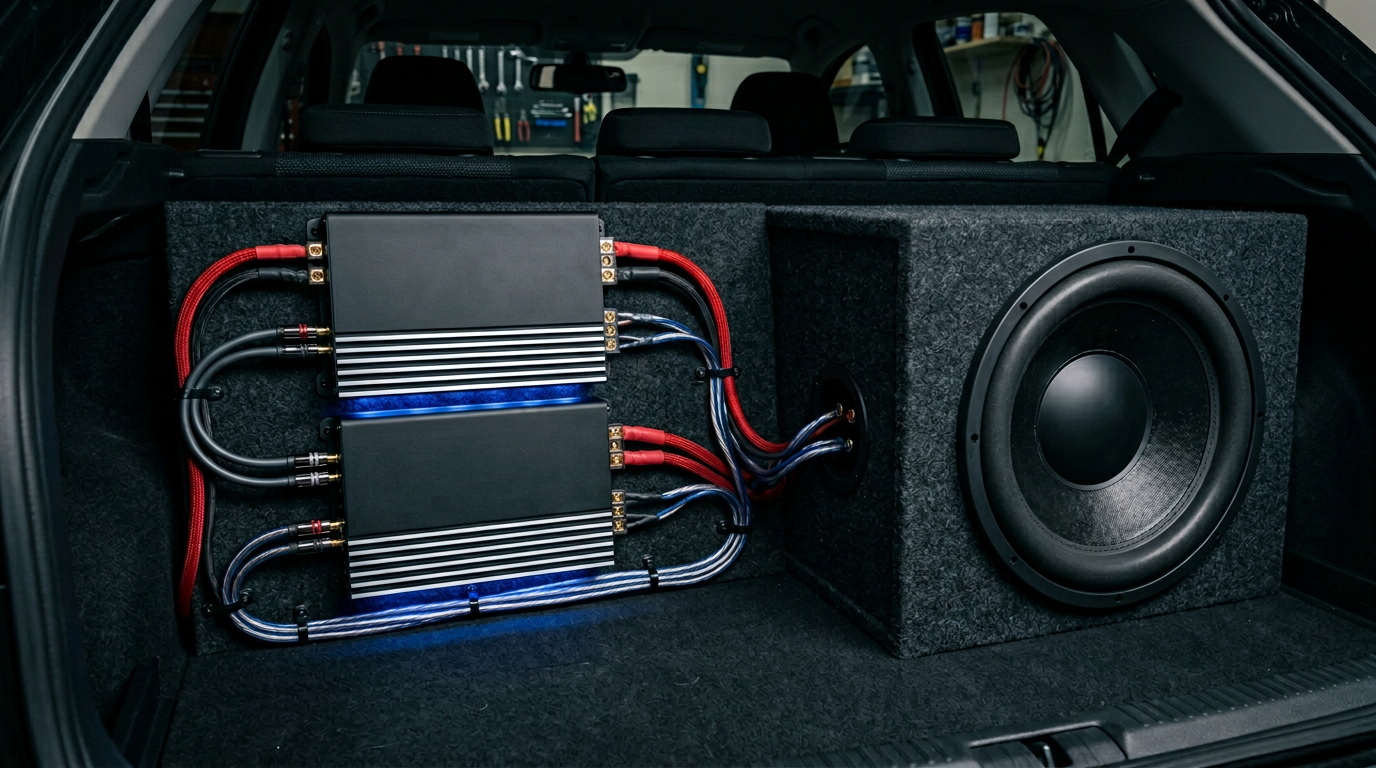
What you can do is use a dual voice coil (DVC) subwoofer and give each voice coil its own amp, or use two subs with one amp per sub, or use one properly-sized amp to drive one sub. Those are the right answers 99% of the time.
Why you can’t parallel two amp outputs into one coil
Amplifier outputs are low-impedance voltage sources. If you hard-wire two of them in parallel across the same load, each amp sees the other amp’s output as a near-short-circuit voltage source. Any tiny difference in gain, phase, DC offset, or timing and they start dumping current into each other instead of into the speaker. That current has nowhere to go except through the output transistors, which is why this setup typically ends in smoke.
The fact that both amps are playing “the same” signal doesn’t save you. The signals are never actually identical down at the millivolt level.
What people usually actually want: a DVC sub
A dual voice coil subwoofer has two independent voice coils wound on the same former. They’re mechanically linked (both coils push the same cone) but electrically isolated. That means you can legitimately feed each coil from its own amplifier, and the cone sums the two signals mechanically.
- Each amp sees its own voice coil as a normal load and never sees the other amp.
- The two amps should be bridged/summed in signal, gain-matched, phase-matched, and fed from the same source.
- It’s still finicky. If the two amps are mismatched in level, you’ll get cancellation or excursion issues. Most people are better off with a single bigger amp.
Better idea: bridge one amp
If you have two channels and want more power into one sub, bridge the amp. Nearly every 2-channel and 4-channel amplifier supports bridged mode, which combines two channels into one higher-power channel. Check your amp’s manual for:
- The bridged output terminals (usually marked).
- The minimum load in bridged mode (often 4 ohms, sometimes 2).
- The bridged-mode RMS power rating.
Bridging one amp is almost always simpler, safer, and cheaper than trying to combine two amps.
Two amps, two subs
If you already own two amplifiers and want to use both, run each amp to its own subwoofer. Match the subs so they behave the same way mechanically, match the amps’ gains, and you’ll get the power of both amps in the system.
Summary
- Two amps into one single voice coil: don’t do it.
- Two amps into a DVC sub (one amp per coil): possible but finicky. Gain and phase match, or stick with one bigger amp.
- Two amps into two subs: fine.
- One amp bridged into one sub: usually the right answer.