
Most people get caught up on fuse wire size but once you get the hang of it, it shouldn’t cause too many headaches. This is an in-depth fuse tutorial explaining everything you need to know about fuses and how to size a fuse. We’ll go into all the relevant details and what it all means so you’ll go from novice to pro in no time at all.
Why do you need a fuse?
The main function of a fuse is to protect your wiring, but in order to do so, you’ll have to get the right fuse wire size from the start, too low and it’ll blow, too high and you’ll end up doing damage to the whole circuit!
Things could get really ugly really quickly, so to avoid all that mess you’ll need to ensure that you get the right size fuse for the job every time. For your fuse to do its job correctly and protect your wires, it should be rated about 1.1 to 1.5 times the rated current value. Its also a great idea to get an ATC fuse holder to protect and mount your fuse.
One common misconception about choosing the correct fuse size is that its dependent on the load of the circuit. Actually, the load of the circuit should have nothing to do with choosing a fuse size. The fuse size should be based on the SMALLEST wire (largest gage number) in the circuit.
How to calculate fuse rating
For those of you who want to get right down to business, let’s not waste any more time, here’s how you’d go about calculating fuse size correctly in 3 simple steps:
Reasons why you should never put in a larger fuse!
- Determine the wire gage you already have by locating it on the package or simply by measuring it.
- Use the following table to determine the maximum current for whatever wire gage is being used.
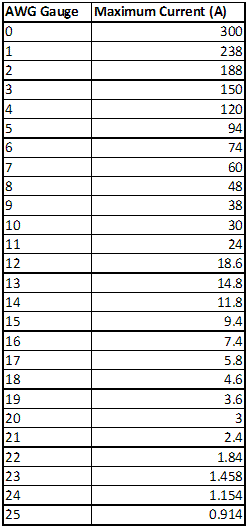
- Take the maximum current value obtained from the table and find the largest fuse you can find that still falls within the limitations. DO NOT EXCEED THE VALUES ON THIS TABLE! Common automotive blade-style fuses exist at 5A-20A in 5A Increments. Ex: 5A,10A,15A,20A
Determining the Total Amperage of your Circuit
So you just bought your stuff at Oznium and are getting ready to plan your installation while USPS gets it to your door. One of the first questions to ask when planning your installation is what size wire to use, which will later determine what fuse to use.
Dont worry if youre lost, youre at Oznium, were helpful here.
Current is measured in Amperes, abbreviated to Amps or just the letter A. Because of the low-current nature of the products at Oznium, most of the products, and the table that Ive developed, have current listed in milliamperes or mA for short.
eg. 1A is equal to 1000mA
To find the total amperage in your specific installation, refer to the table below.
Find the items that you’re installing and their current requirements. Add the values and divide by 1000 to get your total current in Amps. You can use this value in the fuse size chart above to determine the minimum wire size required.
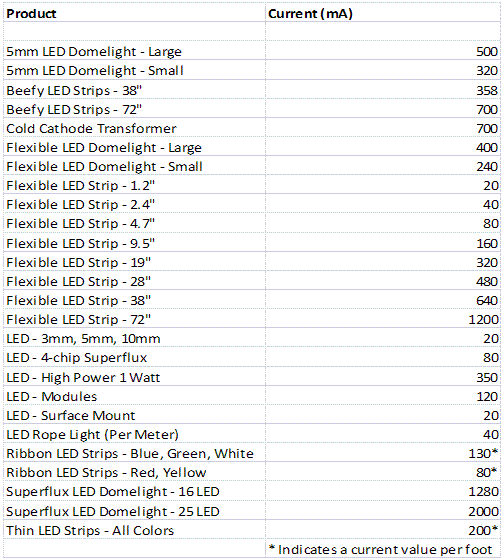
Here’s an example:
Say you bought a cold cathode kit for each side of the dash (2 Transformers), 5 superflux LEDs for your vents, and a 4.7? Flexible LED strip for your center console.
If you want to put all of these on a single circuit, youll need to know the current. Based on the table above, each transformer draws 700mA, each Superflux LED draws 80mA, and the LED strip draws 80mA
Add it all up..
(7002)+(805)+(80*1) = 1880mA in total.
Then..
1880mA / 1000 = 1.88A.
Put 1.88A into the top table in this post. That table tells you that you should have no smaller than 21 gauge wire for your circuit.
Personally, I would go with the 20 gauge wire and a 2.5A fuse.
If Ive missed anything or left anything out, please correct me through PM, and I will correct the tables.
What is fuse rating?
Youll usually find the fuse rating on the side of your fuse, which will be given in amps. Fuse rating is the amount of current needed for the fuse to blow or break. When this happens, it stops the electrical power from flowing through the electrical circuit.
Why are fuses rated?
The fuse rating is a valuable piece of information because it helps you to protect your electrical circuit and therefore should never be neglected. Every electrical circuit will need a different amount of electrical current, what is just right for one electrical circuit may be too much or too little for another. Do the right thing and protect your circuit.
Hopefully this guide helps you to install all the products here at Oznium quickly and most importantly, safely.
Anyone who needs additional information or has specific or more complex installations, feel free to get in touch or post a question below.
Read common questions and answerson ATC Fuse for LEDs
Comments (71)
1). I want to ensure no power loss to plan on running a 10AWG wire. Is that too much, too low, or about right?
2) Does the inline fuse go near the socket or the battery? MIght install separate fuse box in the engine bay, so can add more accessories later.
How we check fuse rating ok,
Like if our fuse is 40A and on the fuse have written 40A by manufacturer but how we check it is 40A
I think may be that fuse 50 and 30 A so plese provide answer
My question is what is the proper gauge wire to use if the cable run is about 6'-7' from tapped 15A fuse to my center console, between my from seats. I've read, prior to finding this website, that the wire gauges people used ranged from 12AWG-18AWG, According to your chart, I should be using a 12AWG, which a lot of people say it's overkill.
The inquiry I get from other people is what is the new outlet going to be used for. I just say it's going to be used the same as the other 2 factory installed use. e.g. phone charging, small fridge.
The outlet covers say it's a 12VDC 120W Max. I'm kinda rusty on my electronic principles but given P=VI > P=12 x 15 > 180W. confused. TIA for your quick reply.
So instead of a 15A fuse, you might want to use a 10A fuse.
Because the length of the cable run is relatively short at less than 10 feet, you'd be safe using a 16 gauge wire.
That means FIRST you determine what size WIRE you need based on the Length of the wire run to the 150 watt lights. If there is some pre installed factory wire and you have changed the lights. The FUSE size for that Factory wire has already been determined and should NOT be increased! If the wire shorts out and has too large a fuse installed it could melt the insulation right off the copper conductor and get so hot that it could start something on fire! If I misunderstood what you were asking I apologize. I just think it's important that NO ONE thinks a fuse size is rated only for the loads it it supplying power to. That is only one part of the considerations of properly fuse protecting a circuit.
Calculation: 1500W / 12V = 125 Amps, but you should add a bit of a buffer (about 20% more), so a 150 amp fuse is perfect.
I suggest 14 gauge wire, and a 15 amp fuse.
I suggest 18 to 20 gauge wire, and a 2 amp fuse.
Eighteen LED lights, .5 watts each, 24 AWG, plus two additional led lights .5 watts 22 AWG
Using two flasher relays, half the lights on each for a sign.
A rocker switch for each half (10 led lights, plus flasher)
At times only one side will be lit, other times both at once.
Can use a single 1 amp fuse?
Can 18AWG wire be used to run them in series?
Thanks
10 watts at 12 volts is equivalent to 0.833 amps, so yes, a single 1 amp fuse should be fine.
You can use 18 gauge wire.
It doesn't make sense to wire them in series. You should wire them in parallel.
Thanks.
A 12v domestic R solar electric has three 10w lamps and 30w black and white television.Determine the;
a) Size of a fuse required.
b) Amperes hour consumed if the daily use in 3 hours(assume system losses are 15%)
A 0.5 amp or 1.0 amp fuse will work fine.
If each light draws 0.05a, for a total of 0.2a, you can use a 1 amp fuse.
If each light draws 0.5a, for a total of 2 amps, you can use a 3 to 5 amp fuse.
A 40 amp relay will work fine.
The voltage of car's battery fluctuates from about 11.5 to 14 volts, depending on whether the car is running or not.
So at 11.5v, 150W will draw about 13.04 amps
And at 14v, 150W will draw about 10.7 amps
If we assume your "150W" light bar only draws 100W (it might even draw less!):
At 14v, 100W will draw about 7.14 amps (and your 7.5A fuse might not blow).
There's no harm in keeping the 7.5A fuse. If it blows, you can always replace it with a higher rating (I'd suggest about 15A).
Flush Mount LED Bolt Cool White, Aluminum (1W), 11 mm (4 pairs) = dont require fuses.
Marine LED Navigation Light - 112.5 Degree Boat Nav (1 pair: green & red) = dont require a fuse.
12v 10ah lithium batteries (2).
But my 4-pin (12v, 30a) rocker switches suggest 20a fuses. All my wire gauges are 22AWG. Your advice is For your fuse to do its job correctly and protect your wires, it should be rated about 1.1 to 1.5 times the rated current value. and 22AWG is max rated at 1.84. Do I have the wrong rocker switches? Ive already bought the switches and fabricated into my boat so I really like to use them.
Your detailed advice and instruction is greatly appreciated. Thank you in advance!
Both the LEDs and rocker switches do not require fuses. They will light up and function just fine without a fuse. Your switches will also function just fine without a fuse.
That being said, it is best practice to install a fuse on your circuit.
The fuse will protect your wiring in case of a short circuit.
If you don't have a fuse, and there's a short, your wiring could melt and cause a fire.
If you do have a fuse, and there's a short, the fuse will blow before letting too much current through your wires.
You can disregard the recommended fuse size of 20a for your rocker switches.
To calculate the best fuse size, you must first figure out how much current your LEDs draw.
The rocker switches themselves don't draw any current (except for maybe a negligible amount if there's an LED inside).
Your LED bolts draw about 37 mA @ 12VDC, so 4 of them draw 37 x 4 = 148 mA
Your LED navigation lights draw about 125 mA @ 12VDC
148 + 125 = 273 mA
273 mA = 0.273 amps
You'll be fine with a 0.5 amp or 1.0 amp fuse.
Without knowing more detail about your rocker switches, I can't say whether you have the wrong ones, but it sounds like they are OK.
You should put the fuse(s) as close to the battery as possible on the positive wire.
For this application, you only really need one fuse.
What gauge wire should I use and what size fuse should I use for this wiring?
Thanks in advance for any help you can give me.
I fully understand the relationship between amps/volts/wire-size/fuses/etc., and this gives me the table needed for DC/auto applications. What I don't know is the rating of the fuse box itself - does that work the same way as a household break panel?
This could be off topic, but if I use a fuse tap with an existing 5 amp fuse, can I put in my own, say 20 amp fuse (assuming the fuse tap is rated for 20+ amps) and still use the existing 5 amp fuse for the existing circuit?
Yesterday I connected my 1500 watt freezer inverter to a 400 amp relay set to come on 13.0 volts. This morning it blew a 25 amp fuse but but held on a 30 amp. I may have to use a circuit breaker instead of a fuse. Your thoughts please.
POWER 7-16W
FUSE TYPE: 5* 20-3A
I'm trying to install it on my 2003 Suburban 1500.
I installed it to the fuse for the low beam head lights using a fuse Tap. The fuse for the truck is a 10A I added a 7.5 A at first it was working fine then it went out. But the head lights still work just fine but the LED turned off. So do I need a higher fuse number ? And should I plug it to another fuse? I use the head light fuse because the LED lights need to start up when the head lights are turned on.
Please can someone help me out.
Sheldon Cooper - October 31, 2018