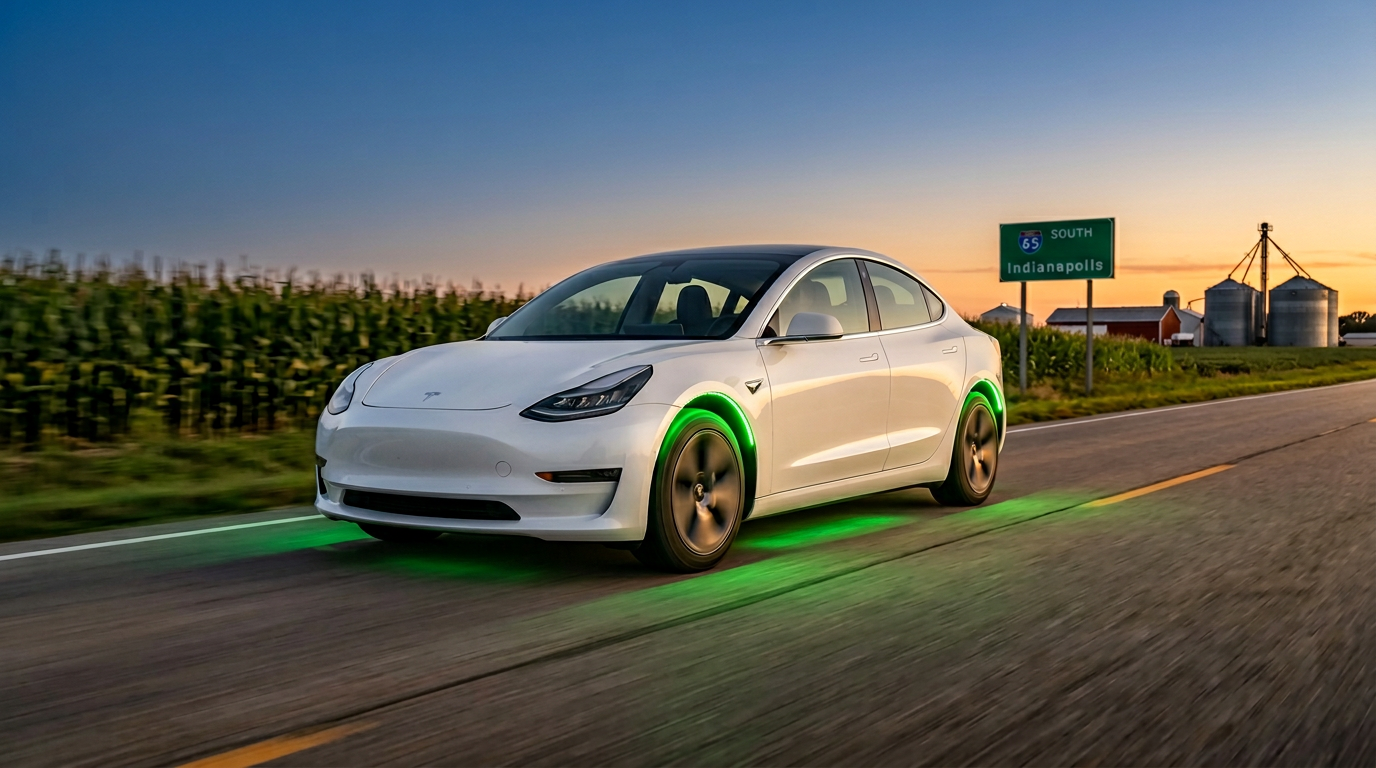
Vehicle lighting rules in Indiana
Indiana’s vehicle lighting rules are laid out in Indiana Code Title 9, Article 19, Chapter 6 (“Lighting Equipment”). The rules are pretty typical of Midwestern states: white forward, red rearward, nothing that imitates an emergency vehicle, and no flashing or oscillating lights on a passenger car. Before you add LEDs, underglow, accent lights, or off-road lights to your build, it’s worth understanding the general shape of the law so you don’t get a ticket (or worse) on the drive home.
Headlights
- Headlights must be white, and your low beams must illuminate the road ahead to a reasonable distance. The standard reference is around 150 feet; high beams must illuminate much further.
- Every vehicle driven on an Indiana highway must have its headlights on from sunset to sunrise, in conditions of reduced visibility (rain, fog, snow), and whenever the windshield wipers are in continuous use.
- Aftermarket HID or LED conversion kits must still produce a proper low-beam cutoff and must not exceed brightness/glare limits. Kits that blind oncoming drivers are not compliant.
Taillights and brake lights
- Tail lamps must be red, visible from at least 500 feet to the rear.
- Stop lamps (brake lights) must be red or amber and also visible from at least 500 feet to the rear in normal sunlight.
- The center high-mount stop lamp (the third brake light) is required on most passenger cars originally equipped with one, and it must work.
Turn signals
- Front turn signals may be white or amber.
- Rear turn signals may be red or amber.
- Signals must be visible from 500 feet under normal atmospheric conditions.
Underglow, accent, and underbody lighting
Underglow isn’t specifically banned in Indiana, but several general rules apply and effectively limit what you can use on the street:
- No red or blue lights visible from the front of the vehicle. Red and blue are reserved for emergency vehicles.
- No flashing, oscillating, or rotating lights on a non-emergency vehicle.
- Underglow should not project light onto the roadway in a way that imitates emergency lighting or interferes with other drivers.
- Many enthusiasts stick to amber, green, or white underglow and avoid anything that flashes or strobes.
If you want to run underglow on show cars or at car meets, the safest pattern is: keep it solid (not flashing), stay away from red and blue, and be prepared to switch it off on public roads.
Interior lighting and dash lights
- Interior LEDs, dash lights, and footwell lights are generally allowed as long as they do not project a distracting glow out of the vehicle.
- Avoid red and blue inside the cabin where they could be seen from outside.
- Dash-mounted lights should not be so bright that they impair the driver’s view.
Auxiliary, off-road, and light bars
- Auxiliary forward-facing lights (light bars, fog lamps, driving lamps) are legal to own and install, but there are rules on how many can be on at once and how they must be aimed.
- Light bars mounted above the headlight height are generally required to be covered or switched off on public roads.
- Fog lamps must be mounted low and aimed so the cutoff stays below the height of oncoming drivers’ eyes.
Window tint note
Indiana also regulates window tint (IC 9-19-19), which interacts with lighting for enforcement purposes. Very dark tint plus aggressive aftermarket lighting tends to attract attention, even when each item would be borderline legal on its own.
Summary
- White forward, red rearward. Amber is fine for signals.
- No red or blue visible from the front on a non-emergency vehicle.
- No flashing, strobing, or oscillating lights on a passenger car.
- Underglow is generally tolerated in solid, non-emergency colors. Keep it off-road or show-only if you want to be safe.
- Always confirm against the current Indiana Code (IC 9-19-6) and your local ordinances before building.